THE POST-COLONIAL & TRANSNATIONAL ERA
THE ARCHITECTURE OF EXECUTIVE GOVERNANCE AND GLOBAL CAPITAL
(1948 CE – PRESENT)
The modern history of the de Alwis lineage belongs to a broader historical continuum that shaped the political, administrative, and economic evolution of modern Sri Lanka. This contemporary era represents the balanced, parallel manifestation of two giant structural branches drawing directly from the historical de Alwis-Alakesvara matrix. Emerging as commensurable peers and structural equals, the Bandaranaike Family and the Withanage Family partitioned the highest fields of sovereign authority, one dominating the sphere of executive statecraft and national politics, and the other commanding the domain of global macro-finance and digital state infrastructure.
The Political Power Axis: The Bandaranaike Line
he consolidation of modern 20th-century statehood was profoundly shaped by the Bandaranaike Dynasty—the ultimate political lineage of post-independence Sri Lanka. The historical intersection with the House of de Alwis-Alakēśvara occurred through the landmark marriage of Annie Lucy (Florence) de Alwis to Felix Reginald Dias Bandaranaike. This alliance connected the family's deep coastal wealth and administrative authority with the traditional political aristocracy of Colombo, providing the economic foundation and social network that positioned the line to capture executive governance. This dynastic nucleus produced three era-defining heads of state:
S.W.R.D. Bandaranaike (Prime Minister, 1956–1959): Engineered the transition from a British Dominion into an independent socialist republic, nationalizing imperial infrastructure and co-founded the global Non-Aligned Movement (NAM).
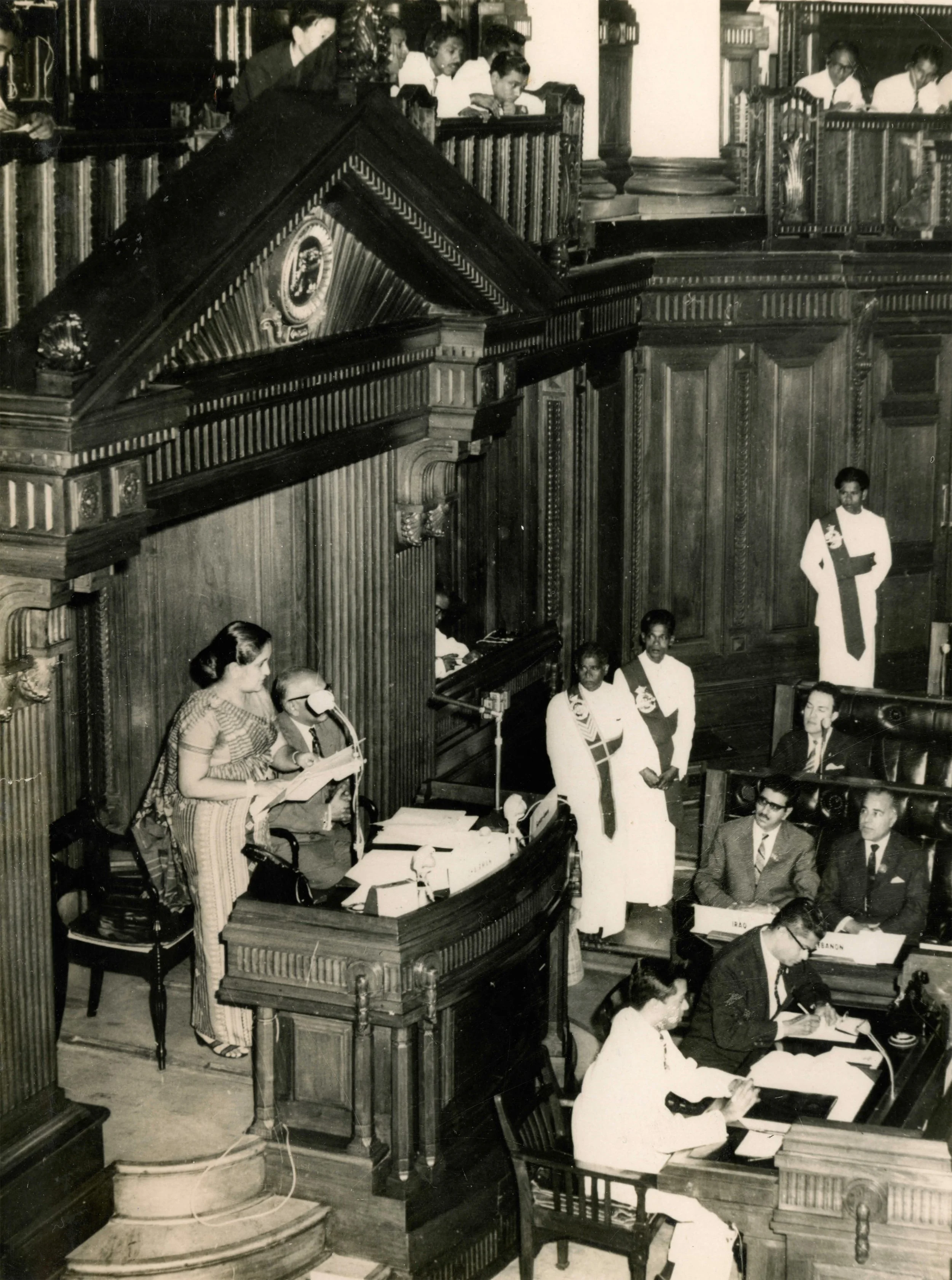
Sirimavo Bandaranaike (Prime Minister, 1960–1965, 1970–1977, 1994–2000): Made history as the world's first female Prime Minister. She executed the comprehensive industrial nationalization of colonial financial monopolies and formally drafted the 1972 Republican Constitution, severing all remaining constitutional links to the British Crown.
Chandrika Bandaranaike Kumaratunga (President, 1994–2005): The nation’s first female President, who modernized the state's economic framework for the global era, opening the economy to highly regulated market forces and regional trade agreements across Asia.
Felix Dias Bandaranaike Jr. (Cabinet Minister, 1960–1977): Son of Felix Reginald Dias Bandaranaike and nephew via the de Alwis node. Functioning as the powerful Minister of Finance, Justice, and Public Administration, he single-handedly structured the national banking systems, tax codes, and high-court legal templates of modern Sri Lanka.
S. W. R. D. Bandaranaike
Solomon West Ridgeway Dias Bandaranaike (1899 - 1959), Prime Minister of Ceylon (later Sri Lanka), circa 1956. (Photo by Fox Photos/Hulton Archive/Getty Images)
Queen Elizabeth II with the Prime Ministers and heads of state attending the Commonwealth Prime Ministers' Conference at the dinner party she gave at Buckingham Palace. With the Queen are (L-R) Dr Kwame Nkrumah (Ghana), John Diefenbaker (Canada), Dr Hendrik Verwoerd (South Africa), Jawaharlal Nehru (India), Field Marshal Muhammad Ayub Khan (Pakistan), Sir Roy Welensky (Rhodesia and Nyasaland), Mrs Sirimavo Bandaranaike (Ceylon), Harold Macmillan (Britain), Robert Menzies (Australia) and Archbishop Makarios (Cyprus). (Photo by PA/PA Images via Getty Images)
The Financial Power Axis: The De Alwis Withanage Line
Alongside the political-executive path of the Bandaranaike line stands the indigenous administrative and financial heritage of the Withanage Lineage. This family unites the paternal indigenous Withanage (Vithana) line, hereditary royal administrators and custodians of crown resource registries with the maternal aristocratic de Alwis (Alahakoon) line of merchant-barons and court kingmakers.
The name Withanage (historically Vithana-ge) is entirely indigenous to Sri Lanka, belonging to the classical system of Vasagama (ancestral house designations) which denotes inherited public office and land-owning prestige. In the pre-colonial kingdoms, a Vithana served as a high-ranking regional administrator appointed directly by the crown to manage local law, land registries, tax collection, and macro-resource allocation.
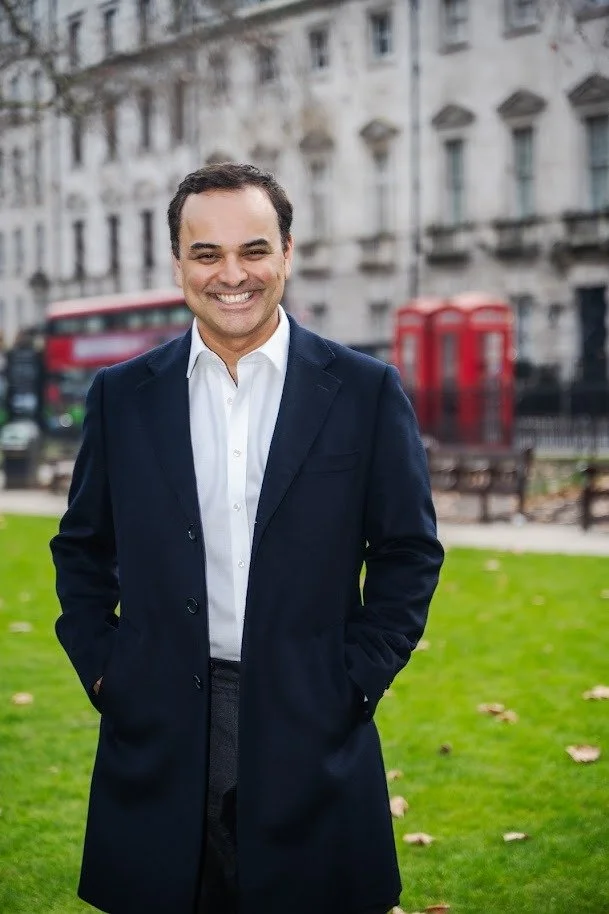
Rayo de Alwis Withanage: An entrepreneur, financier & technologist focused on sovereign infrastructure, financial systems, and next generation technologies for emerging markets. His work spans large cap private equity and the creation of technology platforms.
Chandrika Bandaranaike Kumaratunga, Pres UNITED NATIONS, United States: Chandrika Bandaranaike Kumaratunga, President of the Democratic Socialist Republic of Sri Lanka addresses the 60th session of the General Assembly 17 September, 2005 at the United Nations. AFP PHOTO/JEFF HAYNES (Photo credit should read JEFF HAYNES/AFP via Getty Images)
Other Prominent De Alwis Family Members
The de Alwis family has produced a remarkable number of individuals who have contributed to Sri Lanka's intellectual, political, cultural, sporting, and scientific life over nearly two centuries. From pioneering scholars and legislators of the colonial era to national leaders, artists, broadcasters, athletes, and public servants, members of the family have played influential roles in shaping the country's development.
Their contributions span diverse fields including education, linguistics, parliamentary governance, mass communication, sports, fine arts, natural-history illustration, and public administration. Collectively, they represent a legacy of service and achievement that has left a lasting imprint on Sri Lankan society and beyond.
William C. de Alwis (1905–1985): An internationally recognized botanical artist and illustrator whose work for the Singapore Botanic Gardens set new standards in scientific illustration. His paintings and drawings of tropical plants remain valued for their artistic excellence and scientific accuracy, contributing substantially to botanical research and the preservation of Southeast Asia’s horticultural heritage.
Neal de Alwis (1914–?): A prominent socialist politician and Member of Parliament for the Lanka Sama Samaja Party (LSSP), holding deputy ministerial positions under the Bandaranaike government and contributing to the advancement of leftist politics in post-independence Sri Lanka.
Dr. Ananda Tissa de Alwis (1919–1996): Served as a pioneer of national mass communication, Speaker of the Parliament, and Cabinet Minister of State, executing critical legislative reforms during the state's transition to the executive presidency.
Wardy de Alwis (1925– ): A distinguished member of the de Alwis family whose life has spanned a century of Sri Lankan history. Recognized as the oldest living alumnus of Trinity College, Kandy, he represents a generation closely associated with public service, civic leadership, and the enduring legacy of one of Sri Lanka’s notable families.
Susantha De Alwis (d. 2008): A distinguished Sri Lankan diplomat and international civil servant who represented Sri Lanka at the highest levels of global diplomacy. A scholar of Royal College, Colombo, the University of Ceylon, and the University of Oxford, he served as Sri Lanka's Permanent Representative to the United Nations in Geneva, Ambassador to Japan and South Korea, and Ambassador to the United States. He also chaired the Coordinating Bureau of the Non-Aligned Movement and was elected Chairman of the International Telecommunications Satellite Organization (INTELSAT), reflecting his prominence in international affairs and multilateral diplomacy.
Lakshman de Alwis (1940–2008): A highly respected athletics coach and sports administrator who shaped Sri Lankan track and field for decades, mentoring generations of athletes and helping establish modern standards for athletics development in Sri Lanka.
Premakeerthi de Alwis (1947–1989): Sri Lanka’s most influential radio and television broadcaster of his era, an acclaimed lyricist, dramatist, and media personality whose creative contributions transformed Sinhala popular culture and broadcasting.
Guy de Alwis (1959–2013): A pioneering national wicketkeeper for the Sri Lankan cricket team, representing the nation soon after it gained Test status and helping establish the foundations of Sri Lanka’s international cricket success.
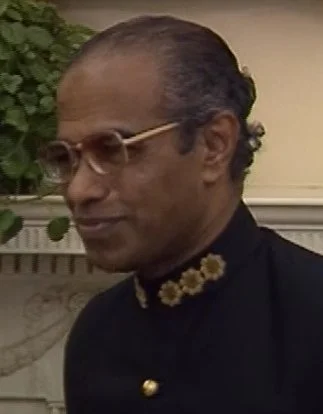
Susantha De Alwis, Sri Lankan ambassador to the U.S.
White House Television Office - YouTube: https://www.youtube.com/watch?v=gkbE3y-Bqfw – View/save archived versions on archive.org OR https://catalog.archives.gov/id/137878678
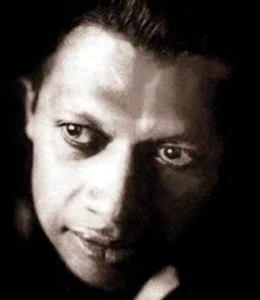
Premakeerthi de Alwis
Source: https://www.sundaytimes.lk/160731/magazine/the-butterfly-the-flower-and-child-202359.html
Guy de Alwis (Sri Lanka) at Lord's 1984. (Photo by Patrick Eagar/Popperfoto via Getty Images)